
Every October, as the rest of the world leans into Halloween, Mexico starts preparing for something entirely different. Marigolds show up in every market, bakeries fill with pan de muertos, and families start pulling out photos of relatives who have passed. It's easy to assume Día de Muertos is just Mexico's version of Halloween, celebrated a day or two later with a different costume theme. It isn't, and once you know where it actually comes from, the difference becomes obvious.
The roots go back long before the Spanish arrived. Aztec and other Nahua peoples dedicated an entire month to honoring those who had died, because in their worldview, death was never something to fear or hide from. It was simply another part of life's cycle, as natural as birth. When Spanish colonizers brought Catholicism to Mexico, those indigenous rituals didn't disappear. They merged with All Saints' Day and All Souls' Day, the Catholic feasts that fall on November 1 and 2, and what emerged was something uniquely Mexican: a holiday that is neither fully indigenous nor fully Catholic, but both at once.
That history is part of why UNESCO added Día de Muertos to its List of Intangible Cultural Heritage of Humanity in 2008. It isn't just a celebration, it's a living tradition that has survived five centuries of change while still meaning the same thing it always did: the dead are not gone, they're just temporarily away, and twice a year they come home.
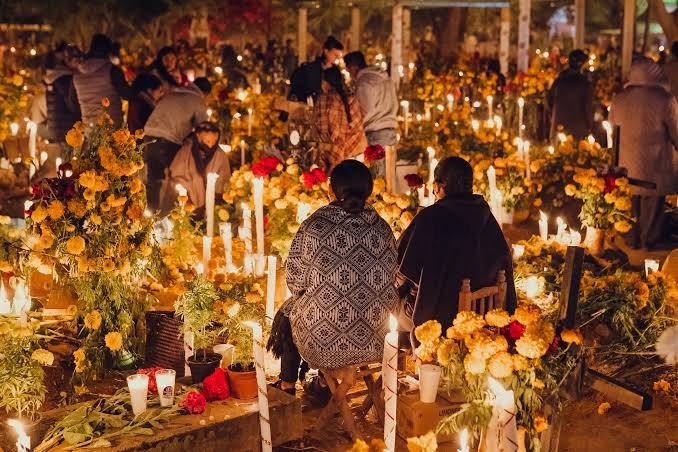
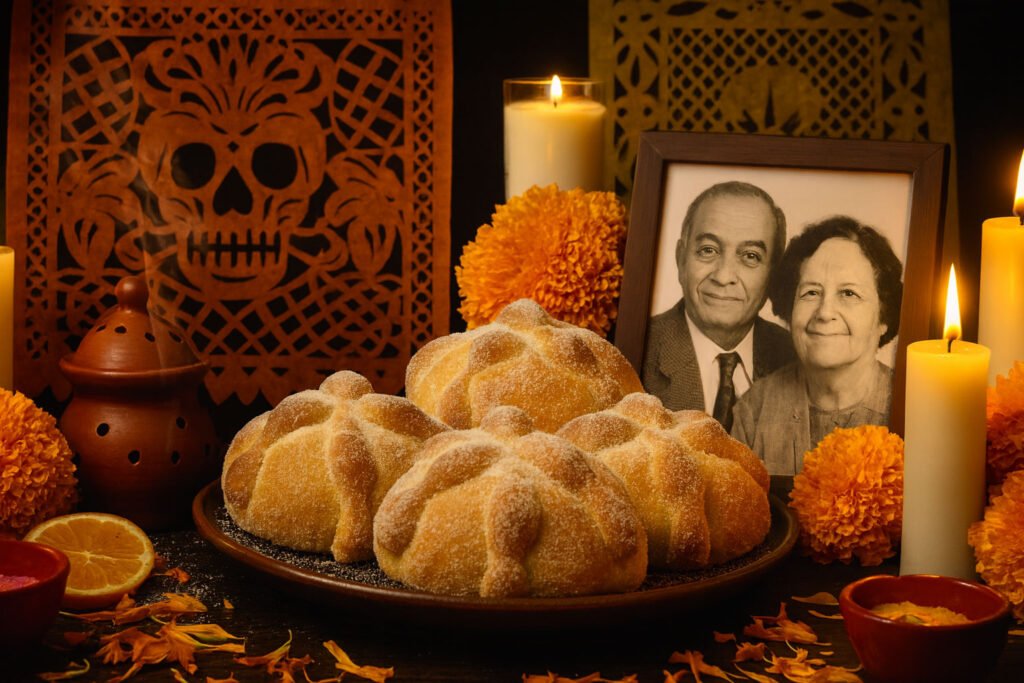
The belief at the center of it all is that on November 1 and 2, the souls of loved ones return to visit their families. Everything about the holiday exists to make that visit possible and welcoming. The most visible expression of this is the ofrenda, the altar families build in their homes, and sometimes right at the gravesite. An ofrenda is not an object of worship, it's closer to a table set for a guest. Families lay out water to quench the thirst of a long journey, the favorite foods and drinks of the person being honored, photographs so the souls are not mistaken for strangers, and a candle for each person being remembered. Pan de muertos, a slightly sweet bread marked with bone shaped decorations, almost always makes an appearance, alongside sugar skulls and the person's favorite dish, whether that's mole, tamales, or a simple cup of coffee.
Getting those souls from the street to the altar is the job of the cempasúchil, the bright orange marigold that becomes impossible to avoid in Mexico City during late October. Petals are scattered in a path from the front door, sometimes all the way to the cemetery, creating a trail that guides spirits home by scent and color. Copal incense burns alongside the flowers, its smoke believed to purify the space and carry prayers upward, a practice with roots in pre Hispanic ritual that long predates the holiday's current form.
All of this stands in sharp contrast to Halloween, which developed an ocean away and for very different reasons. Halloween traces back to Samhain, a Celtic festival marking the time when the veil between the living and the dead was thought to be thinnest, something to be wary of rather than welcomed. Its modern form centers on fright, costumes, and mischief, with black and orange as its signature colors. Día de Muertos runs on an entirely different emotional register. It's loud, colorful, and joyful, built around remembering someone with the foods and stories that made them who they were, not around scaring anyone.
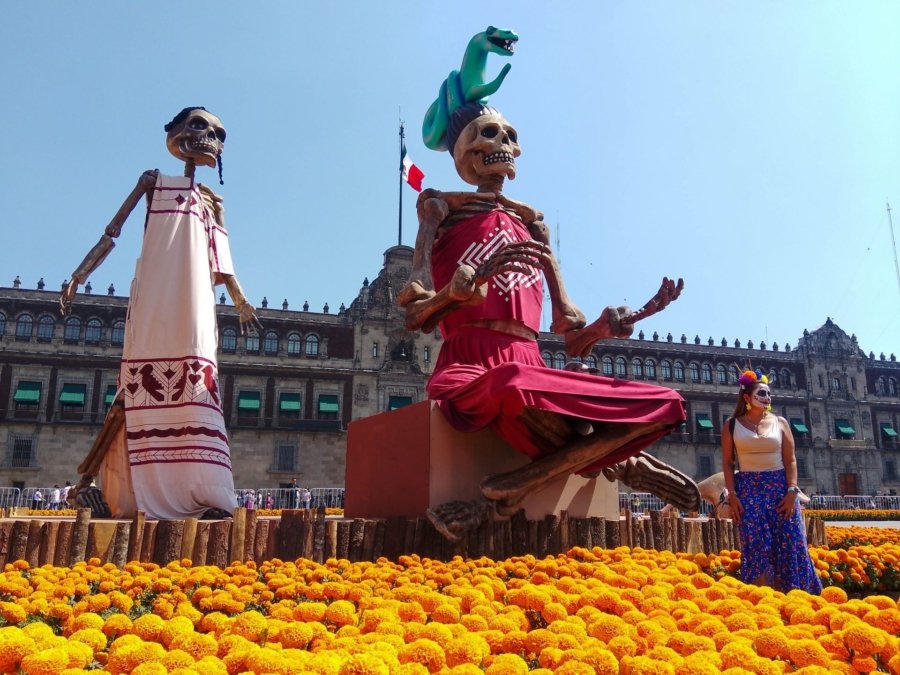
In Mexico City, that joy spills into the streets. The Centro Histórico hosts one of the most elaborate public displays in the country, with a mega ofrenda built in the Zócalo that draws both visitors and locals for days before the holiday itself, and a parade that has become one of the city's most anticipated annual events. Interestingly, that parade didn't always exist. It was staged for the first time in a James Bond film, and the real thing that followed it was the public's response, so Mexico City decided to make it real. It's a fitting origin story for a holiday that has always been about adapting without losing what matters.
If you're in Mexico City around the beginning of November, there's no better way to understand this country than to walk through an ofrenda, take in the scent of copal and marigolds, and watch a celebration that treats remembering someone not as something sad, but as a reason to gather, eat, and tell their story one more time.
Come experience it for yourself. Book your stay at lapalomillabnb.com